
Most traders who blow their first forex account weren't underprepared on strategy. They just didn't understand the pair they were trading. If you're here to learn how to trade EUR/USD, you've already made the right call on which pair to start with. It's the most liquid in the world, and that matters more than most beginners realise.This guide covers the mechanics, timing, and strategies that actually hold up, whether you're just getting started or trying to build something repeatable.
Why EUR/USD Dominates the Forex Market
The numbers aren't close. According to the BIS 2025 Triennial Survey, EUR/USD accounted for roughly 22% of global daily FX turnover across a market averaging $7.5 trillion per day. No other currency pair comes near that figure, and the practical consequences for traders are significant.
That volume produces liquidity, the ease with which you can buy or sell without your order itself moving the price. Deep liquidity keeps spreads tight and orders filling at the price you actually see on screen. In thin markets, those two things break down fast.
On EUR/USD, you'll typically see bid-ask spreads (the gap between what you can buy at and what you can sell at) of 0.5 to 1.5 pips during active hours, where a pip is the smallest standard price increment, equal to 0.0001 for this pair. For most exotic pairs, those numbers are several times higher.
There's also something to be said for transparency. Both the eurozone and the United States publish economic data extensively and on predictable schedules. European Central Bank rate decisions, US Federal Reserve policy statements, inflation figures, employment data, all of it is widely covered and heavily analysed before it even drops.
That doesn't make EUR/USD easy to trade. But it does mean price-moving events are rarely a complete surprise, which is more than you can say for pairs tied to opaque or commodity-dependent economies.
That transparency is part of why EUR/USD suits so many different trading styles. But knowing why the pair is popular is only the starting point.
EUR/USD Trading Hours: Best Time to Trade
Forex runs 24 hours a day, five days a week. Not all of those hours are worth your attention, especially for EUR/USD.
The London/New York overlap, roughly 13:00 to 17:00 UTC, is consistently where the action is. Both major financial centres are operating simultaneously, volume spikes, and spreads compress further.
US economic releases like Non-Farm Payrolls, CPI data, and Fed statements tend to fall in this window, which is why the biggest intraday moves usually happen here rather than anywhere else in the session.
The London opening at around 08:00 UTC is the second-best window. European economic data hits early, institutional order flow picks up sharply after the overnight lull, and volatility builds well before New York comes online.
A lot of new traders assume the Asian session is worth trading for this pair. It generally isn't. Tokyo hours bring thin volume for EUR/USD, spreads widen noticeably, and price tends to consolidate in a range rather than trend. Unless you have a specific forex trading strategy built for low-volatility, range-bound conditions, you're better off staying out.
|
Session |
UTC Hours |
EUR/USD Activity |
Typical Spread |
|
Asian (Tokyo) |
00:00 – 09:00 |
Low |
Wider (1.5–2.5 pips) |
|
London Open |
08:00 – 12:00 |
High |
Tight (0.5–1.0 pip) |
|
London/NY Overlap |
13:00 – 17:00 |
Very High |
Tightest (0.5 pip) |
|
NY Afternoon |
17:00 – 21:00 |
Declining |
Moderate |
Timing matters, but timing alone won't get you far without understanding what you're actually doing when you place a trade.
Understanding EUR/USD Mechanics
Every EUR/USD position is a simultaneous bet on two currencies. Going long means buying euros and selling dollars, so you profit when the euro strengthens relative to the dollar. Going short flips that: you're selling euros and buying dollars, and you profit when the dollar gains ground. Simple in theory. The mechanics around it are where things get more complicated.
1. Leverage and Margin
Leverage lets you control a position much larger than your actual account balance by borrowing from your broker. Under ESMA rules as of 2026, retail traders in the EU are capped at 30:1 on major pairs like EUR/USD. That means a €1,000 account can control a position worth €30,000.
Margin is the collateral your broker holds while that trade stays open, essentially a security deposit. If the market moves against you and your account equity drops below the required margin level, you'll receive a margin call, which is your broker's way of saying they may close your position automatically to stop the losses going further.
The 30:1 cap exists for a reason. A position at full leverage that moves just 50 pips against you wipes out 15% of your margin. Most experienced traders use a fraction of the available leverage, not because they're being cautious for its own sake, but because surviving a run of bad trades requires that the account still be there when conditions improve.
2. Lot Sizes
A standard lot in EUR/USD represents 100,000 units of the base currency. Most retail traders work with mini lots (10,000 units) or micro lots (1,000 units) to keep risk proportionate to account size.
With a micro lot, each pip movement equals roughly $0.10 in profit or loss. Not much in isolation. But multiply that across 10 open positions at higher lot sizes and it adds up quickly.
Practical tip: New traders often underestimate how quickly leverage amplifies losses. A 30:1 position that moves 50 pips against you wipes out 15% of your margin. Size positions carefully relative to your total account balance.
EUR/USD Forex Strategy
There's no single approach that works for every trader or every market condition. EUR/USD accommodates several different styles, and the right fit depends on your available time, your risk tolerance, and how you prefer to analyse markets.
1. Trend Following
EUR/USD trends persistently when monetary policy diverges between the ECB and the Fed. From mid-2024 through early 2025, the pair declined steadily as the Fed held rates higher while the ECB shifted toward easing.
Traders using a simple moving average crossover, the point where a short-term average crosses above or below a long-term average to signal a potential directional shift, captured several hundred pips during that period without needing anything exotic in their setup.
2. Range Trading
Not every market environment produces clean trends. During low-volatility periods, EUR/USD often consolidates between identifiable support and resistance levels. Support is a price zone where buying pressure has historically halted a decline; resistance is where sellers have consistently capped advances.
Range traders buy near support, sell near resistance, and exit if price breaks decisively through either boundary. It's a fairly mechanical approach, which suits traders who find discretionary decisions harder to execute under pressure.
3. News Trading
EUR/USD reacts sharply to scheduled data releases. Non-Farm Payrolls, ECB rate decisions, US CPI, these can move the pair 50 to 150 pips within minutes of the print. When timing and fill quality are critical, execution speed and spread reliability during high-volatility events can make a meaningful difference to outcomes.
According to the IMF Global Financial Stability Report 2025, FX volatility in major pairs rose measurably in the first half of 2025, driven by diverging central bank policy cycles. That environment rewarded traders who understood which releases carry the most weight and had positioned themselves in advance rather than simply reacting once the number was already out.
All three approaches work in the right conditions. None of them work without solid risk management behind them.
Trade EUR/USD with Inveslo
For traders looking to put these strategies into practice, Inveslo offers competitive spreads and reliable execution on EUR/USD, including during high-volatility news events where fill quality matters most. Whether you're trading the London/NY overlap or positioning ahead of a major data release, having a broker that holds up under fast market conditions is a practical advantage worth factoring into your setup.
Risk Management for EUR/USD Traders
Every EUR/USD forex strategy produces losing trades. The question is whether those losses stay manageable or become account-ending.
A stop-loss is an instruction to your broker to close a trade automatically if price moves a specified number of pips against you. It's your primary tool for capping downside on any single position.
A take-profit order does the opposite, closing your trade automatically once price reaches your target level. Using both means you don't need to watch every position tick by tick, which matters a lot when you're trading around a job or other commitments.
Most experienced traders risk no more than 1% to 2% of total account capital on any individual trade. On a $5,000 account, that's $50 to $100 per trade maximum. It sounds conservative. But a strategy with a 50% win rate can still produce a run of six or seven consecutive losses, and if each of those costs 5% of your account, the recovery math becomes brutal.
- Position sizing: calculate your lot size based on the pip distance to your stop-loss, not a fixed dollar amount per trade
- Stop-loss placement: anchor it to technical levels like support and resistance, not arbitrary pip counts
- Risk-to-reward ratio: aim for at least 1:2, meaning your potential gain is at least twice your potential loss on each trade
- Correlation awareness: avoid holding multiple positions that all react the same way to dollar moves, since this quietly multiplies your effective exposure without it being obvious from position count alone
None of these rules are complicated. The hard part is applying them consistently when a trade is running against you and the instinct is to widen the stop or add to a losing position.
Key Takeaways
Trading EUR/USD successfully comes down to understanding the pair's mechanics and applying disciplined risk management consistently. Volume, timing, and strategy alignment matter far more than any single trade outcome.
- Trade the right session: the London/NY overlap delivers the tightest spreads and the most reliable price movement for EUR/USD
- Leverage is a tool, not a shortcut: ESMA caps retail leverage at 30:1 on major pairs; use far less than the maximum while you're developing your approach
- Know your strategy type: trend following, range trading, and news trading each suit different market conditions and trader profiles
- Risk per trade: keep it at 1% to 2% of account capital and use stop-loss orders on every position
As central bank policy cycles continue evolving through 2026, EUR/USD will remain active and full of opportunity. Build your foundation in mechanics and timing before scaling your position sizes.
FAQ
Q1. What is the best time to trade EUR/USD?
A. The London/New York overlap (13:00 to 17:00 UTC) is consistently the most active period. Spreads are tightest, volume is highest, and the major US economic releases that move EUR/USD most sharply fall within this window.
Q2. How much capital do I need to start trading EUR/USD?
A. Many brokers allow you to open an account with as little as $100, though trading micro lots with $500 to $1,000 gives you more practical flexibility for position sizing and withstanding normal price fluctuations without being immediately stopped out.
Q3. What moves EUR/USD the most?
A. US Federal Reserve and European Central Bank interest rate decisions have the largest single-event impact. US Non-Farm Payrolls (released the first Friday of each month) and US CPI inflation data consistently produce the sharpest short-term price reactions.
Q4. Is EUR/USD good for beginners?
A. EUR/USD is generally the most recommended starting pair due to its high liquidity, tight spreads, and abundance of analysis. That said, high liquidity doesn't eliminate risk. Beginners should start with a demo account and small position sizes before risking real capital.
Related articles
 ForexInveslo
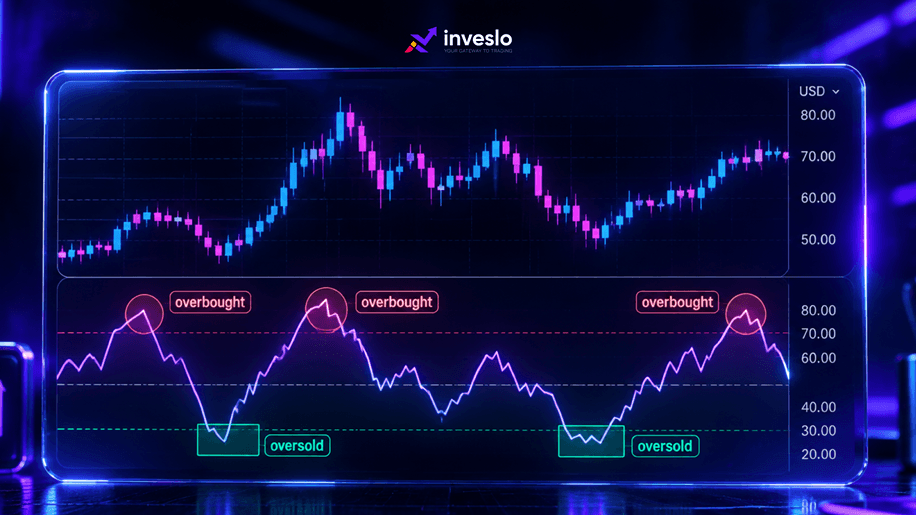
What is RSI Indicator? Overbought, Oversold, and How to Trade It
A price chart can show you where a market is moving, but it does not always make the strength of that move easy to judge. A market can continue rising while momentum starts to weaken..
 ForexInveslo
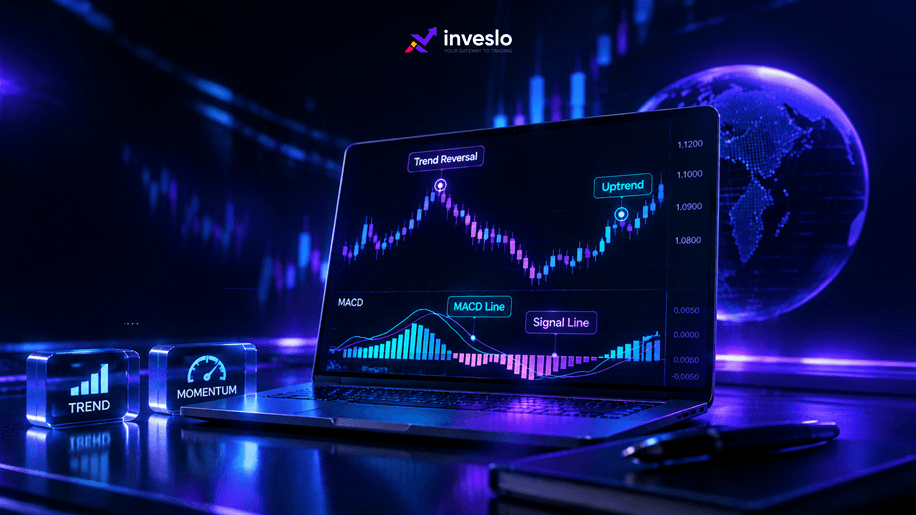
What is the MACD Indicator? How to Spot Trend Reversals and Momentum
A price chart can show that a market is moving, but it does not always make it easy to judge whether momentum is strengthening or weakening...
 ForexInveslo
What is the Consumer Price Index (CPI)?
The Consumer Price Index (CPI) tracks the average change over time in prices consumers pay for a representative basket of goods and services. It is one of the main measures used to monitor consumer inflation.