
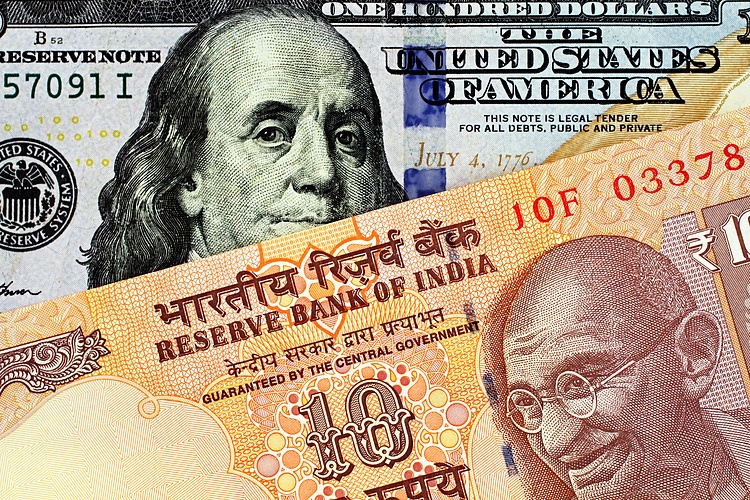

USD/INR extends upside, persistent US Dollar drags Indian Rupee to near fresh record low
- The Indian Rupee tumbles in Monday’s early European session.
- A decline in the Chinese Yuan, persistent USD demand and Trump’s tariff threats continue to undermine the INR.
- The US December S&P Global Composite and Services PMI are due later on Monday.
The Indian Rupee (INR) weakens to near a fresh all-time low on Monday. The local currency remains vulnerable amid the weakening of the Chinese Yuan, fewer rate cut expectations by the US Federal Reserve (Fed) and the threat of tariffs from incoming US President-elect Donald Trump’s administration.
The HSBC final India Services Purchasing Managers' Index (PMI), compiled by S&P Global, eased to 59.3 in December from 60.8 in a preliminary estimate. This reading came in below the consensus of 60.5. The INR remains weak in an immediate reaction to the Indian economic data.
Nonetheless, the Reserve Bank of India (RBI) is likely to sell the US Dollar (USD) to prevent the INR from depreciating. Looking ahead, traders brace for the US S&P Global Composite and Services PMI for December, which are due later on Friday. Also, the Fed’s Lisa Cook is scheduled to speak later in the day.
Indian Rupee remains weak ahead of Indian PMI data release
- "Forward-looking indicators such as new business and future activity suggested that the strong performance will likely continue in the near future," noted Ines Lam, economist at HSBC.
- "Global developments remain the wild card, with the U.S. government due to take office in mid-January 2025," said Radhika Rao, executive director and senior economist at DBS Bank.
- The Indian Rupee is likely to experience slight depreciation in 2025, driven by volatile foreign portfolio investment (FPI) flows and a potentially stronger Greenback, according to the Bank of Baroda report.
- The US Manufacturing PMI climbed to 49.3 in December versus 48.4 prior, according to the Institute for Supply Management (ISM) on Friday. This reading was above the market consensus of 48.4.
- San Francisco Fed President Mary Daly said on Saturday that despite significant progress in lowering price pressures over the past two years, inflation remains uncomfortably above the 2% target, per Bloomberg.
- Fed Governor Adriana Kugler noted on Saturday that inflation remains uncomfortably above the Fed’s target, but the central bank is working on that.
- Richmond Fed President Thomas Barkin stated on Friday that the Fed's benchmark policy rate should stay restrictive until it is more certain that inflation is returning to its 2% goal.
USD/INR’s bullish tone remains in play but overbought RSI warrants caution for bulls
The Indian Rupee trades on a softer note on the day. Technically, the bullish view of the USD/INR pair remains intact as the pair has broken above the ascending trend channel over the past week and is well supported above the key 100-day Exponential Moving Average (EMA) on the daily timeframe.
However, the overbought 14-day Relative Strength Index (RSI) warrants caution for bulls. This suggests that further consolidation cannot be ruled out before positioning for any near-term USD/INR appreciation.
On the upside, the all-time high of 85.81 appears to be a tough nut to crack for bulls. A decisive break above this level could see a rally to the 86.00 psychological mark.
On the flip side, the resistance-turned-support level of 85.55 acts as an initial support level for the pair. Sustained trading below the mentioned level could pave the way to 85.00, en route to 84.43, the 100-day EMA.
RBI FAQs
The role of the Reserve Bank of India (RBI), in its own words, is "..to maintain price stability while keeping in mind the objective of growth.” This involves maintaining the inflation rate at a stable 4% level primarily using the tool of interest rates. The RBI also maintains the exchange rate at a level that will not cause excess volatility and problems for exporters and importers, since India’s economy is heavily reliant on foreign trade, especially Oil.
The RBI formally meets at six bi-monthly meetings a year to discuss its monetary policy and, if necessary, adjust interest rates. When inflation is too high (above its 4% target), the RBI will normally raise interest rates to deter borrowing and spending, which can support the Rupee (INR). If inflation falls too far below target, the RBI might cut rates to encourage more lending, which can be negative for INR.
Due to the importance of trade to the economy, the Reserve Bank of India (RBI) actively intervenes in FX markets to maintain the exchange rate within a limited range. It does this to ensure Indian importers and exporters are not exposed to unnecessary currency risk during periods of FX volatility. The RBI buys and sells Rupees in the spot market at key levels, and uses derivatives to hedge its positions.
Forex News
Keep up with the financial markets, know what's happening and what is affecting the markets with our latest market updates. Analyze market movers, trends and build your trading strategies accordingly.