


Japanese Yen bears retain intraday control amid positive risk tone; ; USD/JPY approaches 144.00
- The Japanese Yen ticks lower as US-China trade deal optimism undermines safe-haven demand.
- Strong Tokyo consumer inflation figures reaffirm bets for additional rate hikes by the BoJ in 2025.
- Dovish Fed expectations might keep a lid on any meaningful USD upside and the USD/JPY pair.
The Japanese Yen (JPY) selling bias remains unabated heading into the European session on Friday, which, along with a modest US Dollar (USD) strength, lifts the USD/JPY pair to a fresh two-week high, around the 143.85 area in the last hour. Investors remain hopeful about a potential de-escalation of the trade war between the US and China, which remains supportive of a positive risk tone and is seen undermining demand for the safe-haven JPY.
Any meaningful JPY depreciation, however, still seems elusive in the wake of the growing acceptance that the Bank of Japan (BoJ) will hike interest rates again in 2025. This marks a big divergence in comparison to the prospects for more aggressive policy easing by the Federal Reserve (Fed), which might cap the USD and help limit losses for the lower-yielding JPY. Nevertheless, the USD/JPY pair remains on track to register gains for the first time in four weeks.
Japanese Yen continues losing ground as optimism over a possible US-China trade deal dampens safe-haven demand
- US President Donald Trump told reporters that the US and China held discussions on Thursday to help resolve the trade war between the world’s two largest economies. Moreover, a White House official said that lower-level in-person talks as well as a phone call between US and Chinese staff had taken place this week.
- Adding to this, China is reportedly mulling to suspend its 125% tariff on some US imports. This fuels hopes of a quick US-China trade resolution, boosts investor confidence, and weakens demand for safe-haven assets like the Japanese Yen.
- However, China's Foreign Ministry spokesperson Guo Jiakun told reporters on Thursday that China and the US have not conducted consultations or negotiations on tariffs. Furthermore, the prospects for additional interest rate hikes by the Bank of Japan should limit deeper losses for the JPY.
- Data released earlier this Friday showed that Tokyo Consumer Price Index (CPI) grew 3.5% year-on-year in April from 2.9% in the prior month. Adding to this, Tokyo core CPI, which excludes volatile fresh food prices, rose 3.4% YoY, or a two-year high, compared to the 3.2% expected and sharply higher than the 2.4% in March.
- Furthermore, a gauge that excludes both fresh food and fuel costs and is closely watched by the BoJ rose 3.1% in April from a year earlier after a 2.2% rise in the previous month. This points to broadening inflation in Japan and gives the BoJ headroom to raise interest rates further after a 50 basis point rate hike earlier this year.
- On the other hand, Federal Reserve Governor Christopher Waller said on Thursday that he would support an interest rate cut if tariffs start weighing on the job market. Separately, Cleveland Fed President Beth Hammack stated that a rate cut as soon as June could be possible if clear evidence of economic direction is obtained.
- This counters Fed Chair Jerome Powell’s remarks last week that the US central bank is well-positioned to wait for greater clarity before considering any adjustments to our policy stance. Nevertheless, traders are still pricing in the possibility that the Fed will lower borrowing costs at least three times by the end of this year.
- The prospects for more aggressive easing by the Fed, to a larger extent, overshadowed mostly upbeat US macro data released on Thursday. In fact, the US Department of Labor reported that Initial Jobless Claims increased modestly to 222,000 for the week ending 19 April and pointed to continued labor market resilience.
- Furthermore, the US Census Bureau reported that Durable Goods Orders surged 9.2% in March, marking the third consecutive monthly increase and far exceeding market expectations of a 2% rise. Transportation equipment, which also recorded its third straight monthly gain, led the increase with a jump of 27% in April.
- Meanwhile, the divergent BoJ-Fed policy expectations, along with hopes that Japan will strike a trade deal with the US, should act as a tailwind for the lower-yielding JPY. Japan's chief negotiator, Economy Minister Ryosei Akazawa, will hold a second round of trade talks with US Treasury Secretary Scott Bessent next week.
USD/JPY could appreciate further once 144.00 is conquered; technical setup some warrants caution for bulls
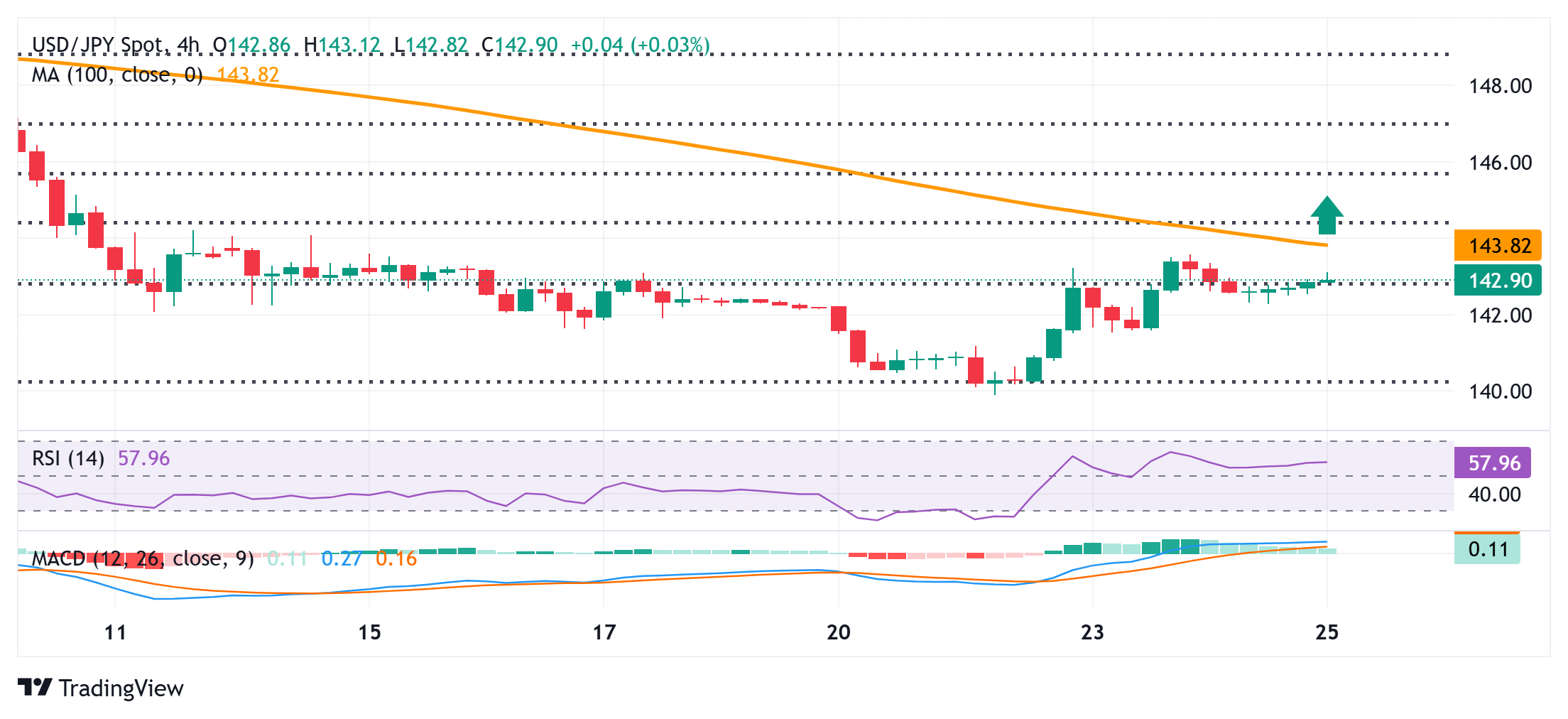
The USD/JPY pair showed some resilience below the 23.6% Fibonacci retracement level of the March-April downfall and the subsequent move back above the 143.00 mark favors bullish traders. Moreover, oscillators on hourly charts have been gaining positive traction and support prospects for additional gains. However, technical indicators on the daily chart – though they have been recovering – are yet to confirm a positive bias. Hence, any further move up might confront stiff resistance near the 144.00 round figure. Some follow-through buying, however, could lift spot prices further to the 144.40 area, or the 38.2% of Fibo. level, which if cleared decisively should pave the way for a further near-term recovery.
On the flip side, dips below the 23.6% Fibo. level might continue to attract some dip-buyers near the overnight swing low, around the 142.30-142.25 region. This is followed by the 142.00 round figure, below which the USD/JPY pair could slide to mid-141.00s en route to the 141.10-141.00 region. The downward trajectory could extend further towards intermediate support near the 140.50 area and expose the multi-month low – levels below the 140.00 psychological mark touched on Tuesday.
Risk sentiment FAQs
In the world of financial jargon the two widely used terms “risk-on” and “risk off'' refer to the level of risk that investors are willing to stomach during the period referenced. In a “risk-on” market, investors are optimistic about the future and more willing to buy risky assets. In a “risk-off” market investors start to ‘play it safe’ because they are worried about the future, and therefore buy less risky assets that are more certain of bringing a return, even if it is relatively modest.
Typically, during periods of “risk-on”, stock markets will rise, most commodities – except Gold – will also gain in value, since they benefit from a positive growth outlook. The currencies of nations that are heavy commodity exporters strengthen because of increased demand, and Cryptocurrencies rise. In a “risk-off” market, Bonds go up – especially major government Bonds – Gold shines, and safe-haven currencies such as the Japanese Yen, Swiss Franc and US Dollar all benefit.
The Australian Dollar (AUD), the Canadian Dollar (CAD), the New Zealand Dollar (NZD) and minor FX like the Ruble (RUB) and the South African Rand (ZAR), all tend to rise in markets that are “risk-on”. This is because the economies of these currencies are heavily reliant on commodity exports for growth, and commodities tend to rise in price during risk-on periods. This is because investors foresee greater demand for raw materials in the future due to heightened economic activity.
The major currencies that tend to rise during periods of “risk-off” are the US Dollar (USD), the Japanese Yen (JPY) and the Swiss Franc (CHF). The US Dollar, because it is the world’s reserve currency, and because in times of crisis investors buy US government debt, which is seen as safe because the largest economy in the world is unlikely to default. The Yen, from increased demand for Japanese government bonds, because a high proportion are held by domestic investors who are unlikely to dump them – even in a crisis. The Swiss Franc, because strict Swiss banking laws offer investors enhanced capital protection.
Forex News
Keep up with the financial markets, know what's happening and what is affecting the markets with our latest market updates. Analyze market movers, trends and build your trading strategies accordingly.