

Mexican Peso extends gains against USD after release of US PPI inflation data
- The Mexican Peso makes gains against the US Dollar after the release of lower-than-expected US PPI inflation data.
- The data weakens the US Dollar and increase the probability of a 0.50% interest rate cut by the Fed in September.
- The Peso suffered after weak Mexican consumer confidence data and central banker comments weighed.
- US inflation data could cause market volatility if results are unexpected.
The Mexican Peso (MXN) is rising in most pairs after the release of lower-than-expected US Producer Price Index (PPI) data weighs on the US Dollar (USD). The data indicates easing inflationary pressures that will probably increase expectations the Federal Reserve (Fed) will take an aggressive approach to cutting interest rates at their meeting in September. Lower interest rates are negative for USD as they reduce foreign capital inflows.
The CME FedWatch tool which measures the market-based probability of the Fed cutting interest rates has elevated the probability of a 0.50% cut by the Fed in September to 55.5% after the release of the PPI data. This contrasts with the roughly 50% probability before the release.
US PPI rose 0.1% in July on a month-over-month basis in line with expectations and below the 0.2% registered in June. Year-over-year, however, it eased to 2.2%, undershooting expectations of 2.3% from an upwardly-revised 2.7% previously, according to data from the US Bureau of Labor Statistics.
PPI ex food and energy rose by 0.0% in July, undershooting the 0.2% forecast and downwardly-revised 0.3% of June. On a YoY basis, PPI ex food and energy rose 2.4%, which was below expectations of 2.7% and the 3.0% in June.
At the time of writing, one US Dollar (USD) buys 18.98 Mexican Pesos, EUR/MXN trades at 20.77, and GBP/MXN at 24.29.
Mexican Peso fell on Monday after weak Consumer data, Banxico comments
The Mexican Peso lost over a percentage point against its key rivals on Monday in a turnaround from the three days prior when it saw a run-up.
The release of Mexican Consumer Confidence data for July further weighed after it revealed a fall from the previous month. Confidence dropped to 46.9 from a five-year high of 47.5 in June, according to data from the Instituto Nacional de Estadistica Geografia e Informatica (INEGI), released on Monday.
Comments from the Bank of Mexico (Banxico) Governor, Victoria Rodríguez Ceja, to El Financiero revealed she supported the justification for the bank’s surprise decision to cut interest rates by 0.25% to 10.75% at its August meeting.
Rodríguez Ceja acknowledged that despite headline inflation hitting 5.57%, the decision had been based on core prices decreasing to 4.05% in July, its eighteenth straight month of declines.
“We expect these effects of the shocks that we observe in non-core inflation to be transitory, so we are still expecting headline inflation to return to its target at the same time, at the end of 2025,” Rodriguez Ceja said.
Her tone may suggest the possibility of further cuts to interest rates materializing down the road if core prices continue falling and headline inflation eventually follows suit. This would be expected to probably be negative for the Peso since lower interest rates make it less attractive as a place to park capital by foreign investors.
Technical Analysis: USD/MXN unfolds correction within downmove
USD/MXN recovers after a protracted fall within a rising channel, as shown on the chart below.
USD/MXN 4-hour Chart
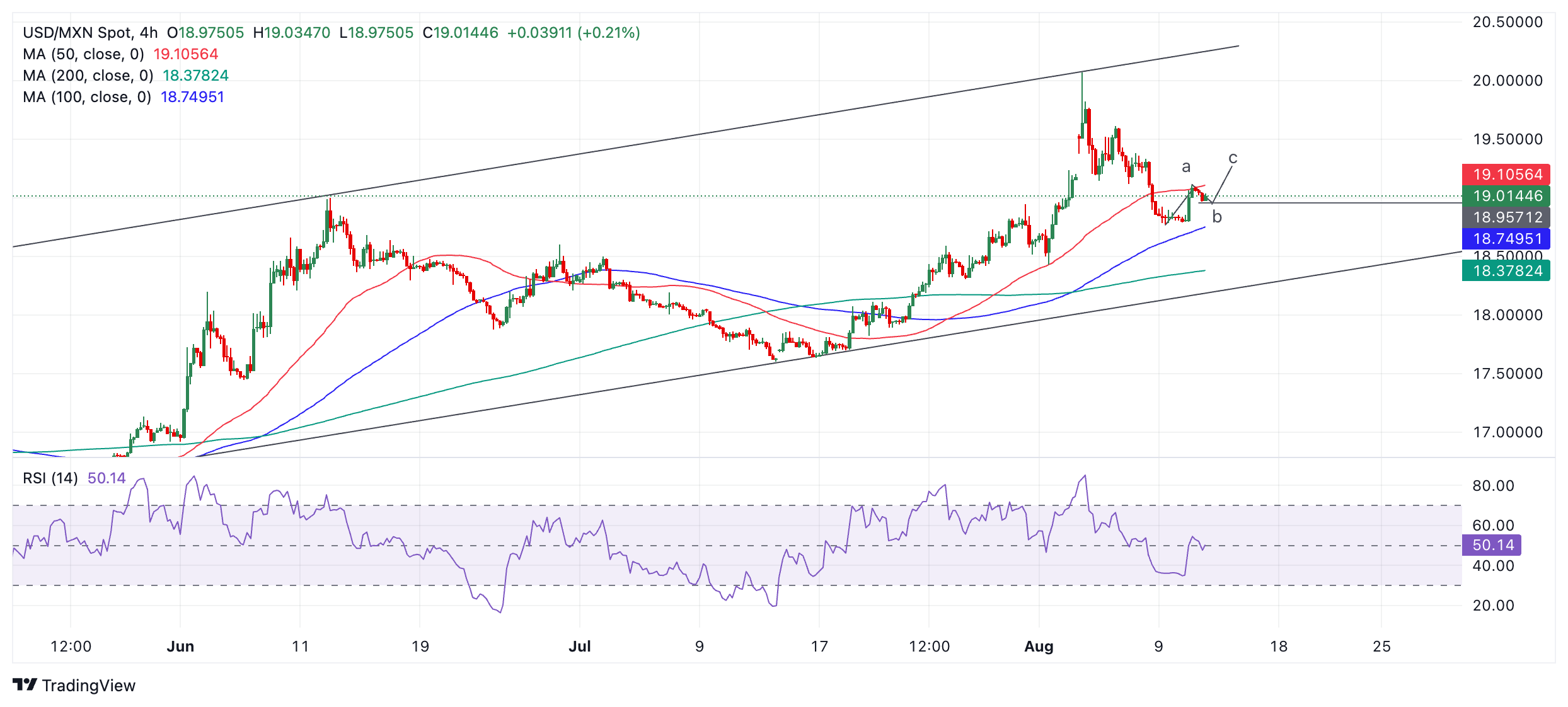
The rebound on Monday looks corrective in nature and, although it will probably stretch a final, third, “c” leg higher to complete an ABC correction, the decline from the top of the channel looks unfinished and is likely to resume again until it reaches the lower channel line at around 18.30. A break back below 18.97 (lows of wave “b”) would provide added confirmation of such a resumption, as would a break below 18.77 (August 9 low).
Such a break lower would probably target 18.35 and the 200-period Simple Moving Average (SMA). The lower channel line will likely provide solid support at roughly 18.30, too.
Economic Indicator
Producer Price Index (YoY)
The Producer Price Index released by the Bureau of Labor statistics, Department of Labor measures the average changes in prices in primary markets of the US by producers of commodities in all states of processing. Changes in the PPI are widely followed as an indicator of commodity inflation. Generally speaking, a high reading is seen as positive (or bullish) for the USD, whereas a low reading is seen as negative (or bearish).
Read more.Last release: Tue Aug 13, 2024 12:30
Frequency: Monthly
Actual: 2.2%
Consensus: 2.3%
Previous: 2.6%
Source: US Bureau of Labor Statistics
Forex News
Keep up with the financial markets, know what's happening and what is affecting the markets with our latest market updates. Analyze market movers, trends and build your trading strategies accordingly.