


EUR/USD declines as US Dollar revives ahead of US NFP
- EUR/USD slumps to near 1.0360 as the US Dollar rebounds, with investors turning cautious ahead of Friday’s US NFP data release for January.
- Chicago Fed President Goolsbee said it is difficult to predict whether inflation will accelerate from overheating or due to US President Trump’s tariffs.
- ECB policymaker Centeno anticipates that interest rates could go below the neutral rate.
EUR/USD corrects to near 1.0360 in Thursday’s North American session. The major currency pair drops as the US Dollar (USD) gains ground after a sharp downside move in the last three trading days. The US Dollar Index (DXY), which tracks the Greenback’s value against six major currencies, rebounds to near 108.00 from the weekly low of 107.30.
The recovery in the US Dollar appears to be the result of investors' caution ahead of the January nonfarm Payrolls (NFP) data, which will be released on Friday. The upbeat ADP Employment Change data for January has set a positive tone for the official employment data. ADP reported on Wednesday that the private sector added 183K workers last month, significantly higher than estimates of 150K and the prior release of 176 K.
Investors will pay close attention to Friday’s US employment data as it will influence market speculation for how long the Federal Reserve (Fed) will keep interest rates steady in the current range of 4.25%-4.50%. Last week, Fed Chair Jerome Powell said that the central bank would make monetary policy adjustments only after seeing “real progress in inflation or at least some weakness in the labor market”.
Meanwhile, Fed officials are uncertain about the monetary policy outlook as they struggle to predict the impact of US President Donald Trump’s economic agenda. On Wednesday, Chicago Fed Bank President Austan Goolsbee said, "If we see inflation rising or progress stalling in 2025, the Fed will be in the difficult position of trying to figure out if the inflation is coming from overheating or if it's coming from tariffs.”
In the Thursday's North American session, the US Department of Labor has reported higher-than-expected Initial Jobless Claims numbers for the week ending Jan 31. Individuals claiming jobless benefits for the first time came in higher at 219K than estimates of 213K and the prior release of 208K.
US Dollar PRICE Today
The table below shows the percentage change of US Dollar (USD) against listed major currencies today. US Dollar was the strongest against the British Pound.
| USD | EUR | GBP | JPY | CAD | AUD | NZD | CHF | |
|---|---|---|---|---|---|---|---|---|
| USD | 0.30% | 0.74% | -0.53% | 0.12% | 0.27% | 0.46% | 0.45% | |
| EUR | -0.30% | 0.44% | -0.82% | -0.18% | -0.03% | 0.16% | 0.14% | |
| GBP | -0.74% | -0.44% | -1.26% | -0.62% | -0.48% | -0.28% | -0.30% | |
| JPY | 0.53% | 0.82% | 1.26% | 0.64% | 0.80% | 0.95% | 0.98% | |
| CAD | -0.12% | 0.18% | 0.62% | -0.64% | 0.15% | 0.33% | 0.32% | |
| AUD | -0.27% | 0.03% | 0.48% | -0.80% | -0.15% | 0.19% | 0.15% | |
| NZD | -0.46% | -0.16% | 0.28% | -0.95% | -0.33% | -0.19% | -0.01% | |
| CHF | -0.45% | -0.14% | 0.30% | -0.98% | -0.32% | -0.15% | 0.00% |
The heat map shows percentage changes of major currencies against each other. The base currency is picked from the left column, while the quote currency is picked from the top row. For example, if you pick the US Dollar from the left column and move along the horizontal line to the Japanese Yen, the percentage change displayed in the box will represent USD (base)/JPY (quote).
Daily digest market movers: EUR/USD weakens as ECB Centeno sees interest rates below the neutral level
- The recovery move in the EUR/USD pair is also driven by some weakness in the Euro (EUR) amid firm expectations that the European Central Bank (ECB) will continue gradually reducing interest rates. Last week, the ECB cut its Deposit Facility rate by 25 basis points (bps) to 2.75%, and officials see more coming this year.
- On Wednesday, ECB policymaker and Governor of the Bank of Portugal Mario Centeno said in an interview with Reuters that it was pretty clear that we have to keep the “trajectory of interest rates going down”. Centeno didn’t provide a specific policy-easing path but highlighted that we need to go to a neutral rate “sooner rather than later”. Centeno cautioned that the ECB could go “below the neutral rate” as the Eurozone economy is not “strong enough to support inflation at 2%”.
- When asked about the impact of a global trade war on the Eurozone due to US President Donald Trump’s tariff agenda, Mario Centeno said that a 10% levy on China would have some deflationary effect in the trading bloc. He added that Trump’s tariffs on Europe can be “quite impactful," but scrutinization of the impact of global tariffs would be predictable after March.
- Market participants anticipate that US President Trump will turn to the Eurozone after dealing with China. Over the weekend, Trump said that tariffs will definitely happen with the European Union and “I can tell you that because they've really taken advantage of us".
- On the economic front, Eurozone Retail Sales data for December has come in weaker than expected. Month-on-month Retail Sales declined at a faster pace of 0.2% than estimates of 0.1%. In November, Retail Sales remained flat.
Technical Analysis: EUR/USD slides below 1.0400
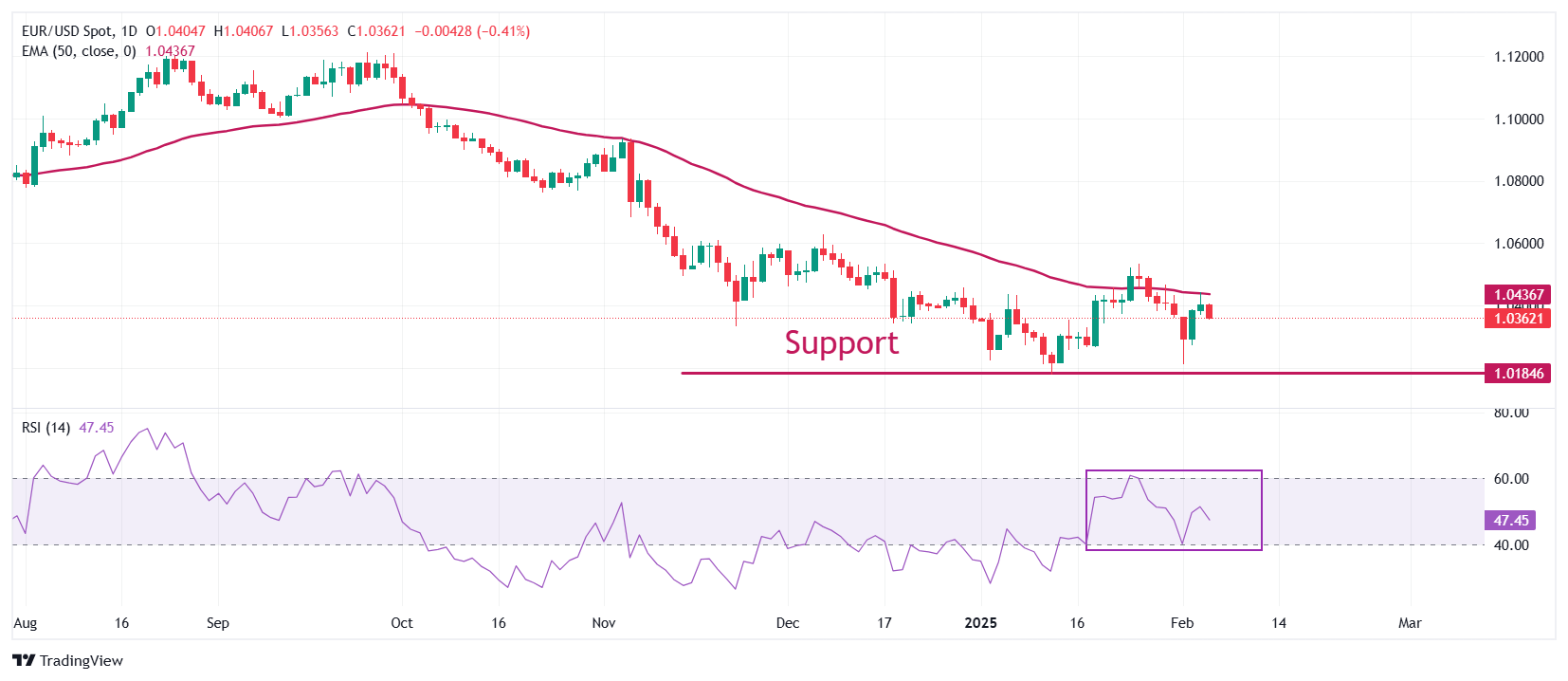
EUR/USD drops to near 1.0360 in North American trading hours on Thursday after failing to sustain above the key level of 1.0400 the prior day. The major currency pair faces pressure near the 50-day Exponential Moving Average (EMA) around 1.0437, suggesting that the overall trend is still bearish.
The 14-day Relative Strength Index (RSI) oscillates in the 40.00-60.00 range, indicating a sideways trend.
Looking down, the January 13 low of 1.0177 and the round-level support of 1.0100 will act as major support zones for the pair. Conversely, the psychological resistance of 1.0500 will be the key barrier for the Euro bulls.
Economic Indicator
Nonfarm Payrolls
The Nonfarm Payrolls release presents the number of new jobs created in the US during the previous month in all non-agricultural businesses; it is released by the US Bureau of Labor Statistics (BLS). The monthly changes in payrolls can be extremely volatile. The number is also subject to strong reviews, which can also trigger volatility in the Forex board. Generally speaking, a high reading is seen as bullish for the US Dollar (USD), while a low reading is seen as bearish, although previous months' reviews and the Unemployment Rate are as relevant as the headline figure. The market's reaction, therefore, depends on how the market assesses all the data contained in the BLS report as a whole.
Read more.Next release: Fri Feb 07, 2025 13:30
Frequency: Monthly
Consensus: 170K
Previous: 256K
Source: US Bureau of Labor Statistics
America’s monthly jobs report is considered the most important economic indicator for forex traders. Released on the first Friday following the reported month, the change in the number of positions is closely correlated with the overall performance of the economy and is monitored by policymakers. Full employment is one of the Federal Reserve’s mandates and it considers developments in the labor market when setting its policies, thus impacting currencies. Despite several leading indicators shaping estimates, Nonfarm Payrolls tend to surprise markets and trigger substantial volatility. Actual figures beating the consensus tend to be USD bullish.
Forex News
Keep up with the financial markets, know what's happening and what is affecting the markets with our latest market updates. Analyze market movers, trends and build your trading strategies accordingly.