

Mexican Peso rises after Powell’s comments and Fed hold rates
Most recent article: Mexican Peso reaches weekly high against US Dollar amid unchanged Federal Reserve policy
- Mexican Peso gains over 0.80% against the US Dollar following the Federal Reserve's decision to keep interest rates steady and to slow its balance sheet reduction starting in June.
- Fed Chair Jerome Powell underscored a cautious, data-dependent approach to future monetary policy adjustments, pointing to ongoing uncertainties about inflation reaching the 2% target.
- This dovish shift includes a notable decrease in the monthly reduction of Treasury holdings, from $60 billion to $25 billion.
The Mexican Peso rallied sharply against the US Dollar on Wednesday after the Federal Reserve decided to hold rates, but also opened the door to reducing the Quantitative Tightening program, beginning in June. At the time of writing, the USD/MXN trades at 16.98, down more than 0.80%.
During his press conference, Fed Chairman Jerome Powell said it wouldn’t be appropriate to cut rates until they have confidence that inflation is trending toward its 2% goal, adding that this year's inflation data “has not given us that greater confidence.” Powell stated they would decide monetary policy “meeting by meeting” while adding that slowing the pace of balance sheet runoff “will ensure a smooth transition for money markets.”
Powell said the Fed’s belief that monetary policy is sufficiently restrictive to curb inflation and disregarded the potential of hiking rates when he asked.
Earlier, the Federal Reserve decided to keep the federal funds rate unchanged at 5.25%-5.50 %. They acknowledged that risks to achieving the Fed’s dual mandate on employment and inflation “moved toward better balance over the past year.” Although they said there’s progress on inflation, recent data showed that it has stalled.
Fed policymakers added that they would begin to reduce holdings on its balance sheet on US Treasury securities from $60 billion to $25 billion starting in June.
Mexico’s economy is slowing, the Instituto Nacional de Estadistica Geografia e Informatica (INEGI) revealed on Tuesday. The Gross Domestic Product (GDP) for Q1 2024 grew by 1.6% YoY, missing estimates of 2.1% and trailing 2023’s last quarter at 2.5%. On a quarterly basis, the growth rate showed an improvement from 0.1% to 0.2%, exceeding forecasts for no growth.
Daily digest market movers: Mexican Peso appreciates on mixed US data
- Data published in April showed that Mexico’s inflation was mixed. Headline inflation rose, mostly attributed to a jump in Oil prices. Conversely, underlying prices dipped, justifying the Bank of Mexico’s (Banxico) decision to lower rates.
- Although most analysts estimate Banxico will keep rates unchanged at 11.00%, new data could prompt heated discussions among Banxico’s Governing Council members on May 9.
- Last week, Banxico Governor Victoria Rodriguez Ceja said the central bank would be data dependent. However, weak GDP data could lead to a “live meeting” on May 9.
- Citibanamex Survey showed that most analysts expect Banxico to hold rates unchanged at the May meeting. The median foresees a rate cut in June, while they estimate the main reference rate to end the year at 10.00%, up from 9.63% previously.
- Measures of business activity in the US were mixed, as S&P Global Manufacturing PMI came at 50.0, higher than expected but trailing March’s 51.9. Contrarily, the ISM Manufacturing PMI came at 49.2, below estimates of 50.0, and signaling contraction in the sector once again after March’s expansion of 50.3
- ADP Employment Change rose by 192K in April, exceeding estimates of 175K but below March’s 208K upwardly revised figure. Further jobs data showed the JOLTS Job openings fell in March to their lowest level, from 8.813 million to 8.488 million.
- Fed is expected to keep rates unchanged at May 1 meeting, though traders will be eyeing Fed Chair Jerome Powell’s press conference. A hawkish tilt could trigger a jump in favor of the Greenback; otherwise, the USD/MXN could resume its downtrend.
- Data from the Chicago Board of Trade (CBOT) suggests that traders expect the fed funds rate to finish 2024 at 5.100%, up from 5.080% on Tuesday.
USD/MXN technical analysis: Mexican Peso regains control, USD/MXN dives below 200-day SMA
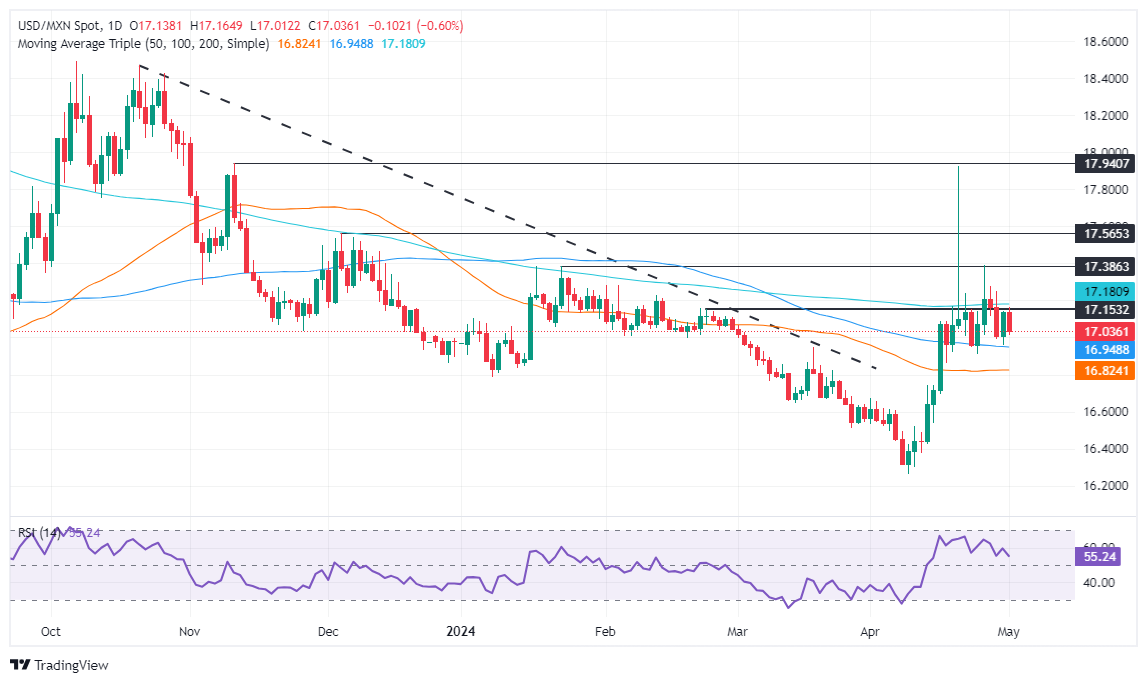
The Mexican Peso trims some of its Tuesday’s losses, as the USD/MXN struggled to crack the 200-day Simple Moving Average (SMA) at 17.17, turning lower toward the 17.00 figure. If sellers push the price below that level, immediate support emerges at the 100-day SMA at 16.94, followed by the 50-day SMA at 16.81 before challenging last year’s low of 16.62.
Conversely, if buyers regain the 200-day SMA, it will pave the way to test the weekly high of 17.24, followed by the January 23 swing high of 17.38, and the year-to-date (YTD) high of 17.92, ahead of 18.00.
Mexican Peso FAQs
The Mexican Peso (MXN) is the most traded currency among its Latin American peers. Its value is broadly determined by the performance of the Mexican economy, the country’s central bank’s policy, the amount of foreign investment in the country and even the levels of remittances sent by Mexicans who live abroad, particularly in the United States. Geopolitical trends can also move MXN: for example, the process of nearshoring – or the decision by some firms to relocate manufacturing capacity and supply chains closer to their home countries – is also seen as a catalyst for the Mexican currency as the country is considered a key manufacturing hub in the American continent. Another catalyst for MXN is Oil prices as Mexico is a key exporter of the commodity.
The main objective of Mexico’s central bank, also known as Banxico, is to maintain inflation at low and stable levels (at or close to its target of 3%, the midpoint in a tolerance band of between 2% and 4%). To this end, the bank sets an appropriate level of interest rates. When inflation is too high, Banxico will attempt to tame it by raising interest rates, making it more expensive for households and businesses to borrow money, thus cooling demand and the overall economy. Higher interest rates are generally positive for the Mexican Peso (MXN) as they lead to higher yields, making the country a more attractive place for investors. On the contrary, lower interest rates tend to weaken MXN.
Macroeconomic data releases are key to assess the state of the economy and can have an impact on the Mexican Peso (MXN) valuation. A strong Mexican economy, based on high economic growth, low unemployment and high confidence is good for MXN. Not only does it attract more foreign investment but it may encourage the Bank of Mexico (Banxico) to increase interest rates, particularly if this strength comes together with elevated inflation. However, if economic data is weak, MXN is likely to depreciate.
As an emerging-market currency, the Mexican Peso (MXN) tends to strive during risk-on periods, or when investors perceive that broader market risks are low and thus are eager to engage with investments that carry a higher risk. Conversely, MXN tends to weaken at times of market turbulence or economic uncertainty as investors tend to sell higher-risk assets and flee to the more-stable safe havens.
Forex News
Keep up with the financial markets, know what's happening and what is affecting the markets with our latest market updates. Analyze market movers, trends and build your trading strategies accordingly.